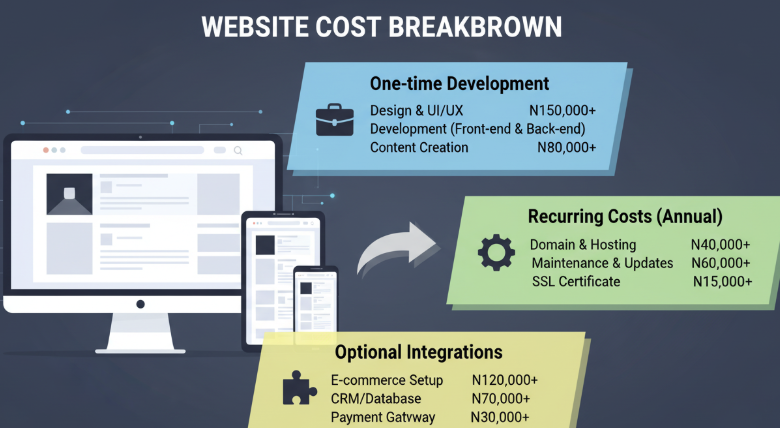
For small and medium sized enterprises or SMEs across Nigeria, launching a professional online presence often begins with the five page website package. This starter solution is designed to provide credibility and a basic digital storefront without the complexity and cost of a large custom build. However, understanding exactly what you are paying for and what annual expenses follow is critical for local businesses operating in a market with volatile costs.
Clarity on deliverables and cost is especially important for Nigerian businesses, where fluctuating exchange rates directly affect pricing for key digital assets. By knowing the standard inclusions and anticipating recurring fees, founders can transform their website from a mere expense into a strategic revenue generating tool.
Part 1: What is in a Standard 5-Page Package?
The 5-page package is typically a brochure style site, meaning its primary function is to inform and capture leads, not to process transactions like an e-commerce store. The five pages usually cover the fundamental pillars of a business identity:
- Home page
- About Us page
- Services or Products page
- Contact Us page
- Blog or Gallery page
Essential Technical Deliverables
A well defined package will include several nonnegotiable technical features. If a designer quotes a low price but excludes these, the result will be a website that fails to perform. The most essential inclusion is a mobile responsive design, ensuring the site adapts seamlessly to the majority of Nigerian users who access the internet primarily on their phones.
Beyond the visuals, the package must include basic administrative and optimization setup. This involves logo and favicon integration, setting up a functional contact form to collect leads, and integrating social media links to connect your digital platforms.
Features That Drive Conversions
A basic website should also be built with sales in mind. Expect your developer to focus on foundational Page Speed Optimisation. A fast loading site is critical because a slow experience drives potential customers away. Furthermore, clear Call to Action or CTA buttons should be strategically placed to guide visitors towards the desired action, such as requesting a quote or downloading a brochure.
Building trust is a major factor in the Nigerian digital sphere. For this reason, successful packages often include a dedicated section for displaying testimonials and customer reviews. One increasingly valuable feature that caters to the local market is WhatsApp integration. This allows potential clients to bypass traditional email forms and reach the business directly via a trusted messaging application.
Understanding the Expected Scope
The following table breaks down what you should generally expect from a typical mid tier 5-page package in Nigeria, and what items typically incur extra fees.
| Feature Category | Standard Inclusions | Common Exclusions/Add-Ons |
| Design & Technical | Mobile Responsive Design, Theme Customization, Basic Security (SSL) | Custom UI/UX Design, Premium Plugin Licensing |
| Content & SEO | Basic On Page SEO, Contact Form Setup, Google Indexing | Professional Copywriting (per page), Advanced Conversion Optimization |
| Infrastructure | 1 year Hosting & Domain, CMS Setup (e.g., WordPress) | Dedicated Hosting, Advanced CDN/Security Firewalls |
| Support | 3 Months post launch support, Technical guide for management, Weekly Backups | Ongoing content updates, Monthly Maintenance Retainer |
Part 2: Decoding the Cost Structure
The initial cost of a five page website package in Nigeria can be intimidating, especially due to the wide range of prices available. A legitimate, professionally built 5-page site will typically fall within the range of ₦100,000 and ₦350,000. The price is determined by two major components: the developer’s time and the cost of third party tools.
The developer’s fee alone for this level of project may range from ₦70,000 to ₦350,000. The higher end of this range often accounts for a developer with greater experience or an agency with better project management capacity.
Hidden Costs and Currency Volatility
A significant cost factor that is often priced in US dollars is the website’s theme or template. For quality designs, the theme cost can range from ₦90,000 to ₦375,000 when converted. This is a critical point of transparency. Since core components like themes, plugins, and hosting are usually priced globally, they are heavily impacted by the Naira exchange rate. For example, the rate was approximated at ₦1,643 per USD in a 2024 estimate. This high rate means founders must inquire whether their quote is based on a fixed Naira price or a live conversion, especially when dealing with recurring expenses.
In many cases, the price of a basic SSL certificate, which secures the site and ensures a padlock icon is displayed, is included. However, depending on the required security level, the cost for standard security can vary greatly from ₦45,000 to ₦1,500,000 per year.
For a broader perspective on budgeting, you may want to read the related article: How much does a business website cost in Nigeria?.
Part 3: What to Expect: Timeline and Recurring Expenses
A common mistake is assuming the project will be completed in a few days. While the initial build is fast, a professional approach requires strategic planning and content collation.
The Development Timeline
The realistic total duration for delivering a quality 5-page website, including revisions and client feedback time, is 4 to 8 weeks. This timeframe is usually broken down into phases:
- Planning and Strategy: Defining the target audience, site goals, and gathering content (1 to 2 weeks).
- Design Mockups: Creating the visual layout and getting client approval (1 to 3 weeks).
- Core Development: Coding and integrating the pages and features (1 to 2 weeks).
Rushing the timeline often leads to a site that looks good but lacks the optimization necessary for lead generation and search visibility.
The Unavoidable Annual Expenses
Many business owners forget that the initial development fee is a one time cost, but they will face recurring annual costs. These costs are essential to keep the site online, fast, and secure.
- Hosting and Domain: This is the fee for the site’s address and the server space it occupies. Annual shared hosting and domain registration costs are a necessary investment, generally ranging from ₦60,000 to ₦120,000 per year for small sites. Domain costs can be as low as ₦8,600 per month or up to ₦12,000 or more per month when calculated annually for a reliable provider.
- Maintenance: The developer may offer a period of free support, but ongoing site maintenance starts at ₦35,000 per month for basic packages. If you want a comprehensive plan that includes monthly plugin updates, security monitoring, and regular performance checks, expect to budget between ₦120,000 and ₦500,000 per year. This maintenance includes critical security measures and a 99.9% uptime guarantee from the hosting provider.
Part 4: Where to Invest for the Highest Return
For SMEs, the investment in a website should be judged by its return on investment, not its low price tag. The biggest difference between a cheap site and one that genuinely works is the quality of the content.
Most affordable packages assume that you, the business owner, will supply all the text and images. This often results in poorly written or generic copy that fails to persuade visitors. Recognizing this, higher cost packages, sometimes priced around ₦340,000, secure professional web content writing of up to 300 words per page. Separately, professional copywriting services can add an extra ₦100,000 to ₦500,000 to the total project cost.
This expenditure on quality, conversion focused content is an essential investment. A beautiful website with poor conversion is a primary failure point for many digital ventures. By prioritizing features like persuasive headlines, benefit oriented copy, and clear engagement paths, you ensure your 5-page site does more than just exist, it actively generates revenue for your business.